ESPLÚS, 1947 Imma Pueyo
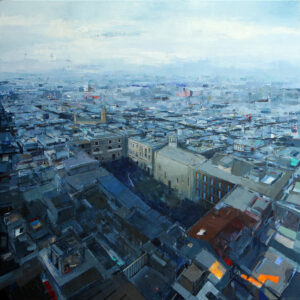
Through the observation and analysis of urban forms, architectural structures, the arrangement of spaces and their functions, Pueyo presents the metropolis as a space for reflection.
Her painting simplifies forms, alters perspectives, intensifies colours and transforms geometry into expression, but above all, it proposes a different way of looking at everyday life.
BURS,URBS. The City Transformed by the Gaze
by Xavier Figueras i Nogués. Corresponding Member of the Royal Academy of Fine Arts of Sant Jordi
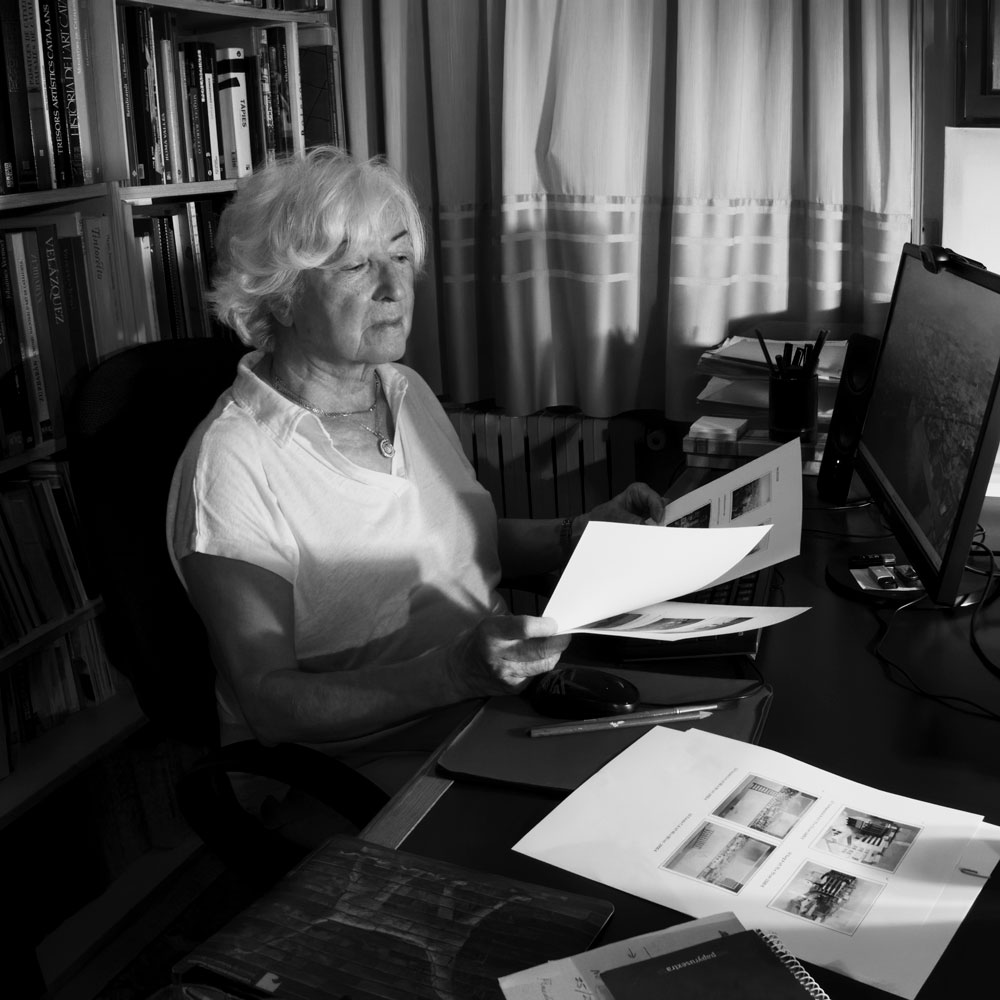
Imma Pueyo, art historian, art critic and visual artist, has developed an intense and multifaceted career in the fields of art and culture. Painting is one of the central pillars of her creative practice, and her work is the result of an ongoing process of inquiry in which she studies, reflects and experiments, developing her own distinctive perspective on the contemporary world.
With the exhibition BURS, URBS, Pueyo continues this artistic journey, turning her attention to the urban landscape. The exhibition’s very title contains one of the project’s key conceptual ideas: BURS is formed by rearranging the same letters as URBS, the Latin word for city. This formal displacement of the word also suggests a transformation in the way we understand and perceive the urban environment: the city is not a fixed reality, but one that changes over time and through the gaze of those who observe it. Thus, between URBS and BURS, between what the city is and what it becomes when seen through another’s gaze, a space for reflection emerges that runs throughout the exhibition.
Through the observation and analysis of urban forms, architectural structures, the arrangement of spaces and their functions, Pueyo presents the metropolis as a space for reflection: a dense, complex, fragmented and constantly changing urban organism, in which the city is constructed through the superimposition of volumes that create visual rhythms and balances.
The geometric forms of buildings combine with freer shapes, generating a tension between order and spontaneity. A flexible perspective allows the urban space to be viewed both panoramically and in fragments. Drawing defines the architecture through essential lines, planes and contours. In this process, colour plays a fundamental role: reds and oranges bring energy, intensity and vitality, while blues and whites introduce depth, atmosphere and silence.
Each element contributes to a visual construction that does not seek to reproduce the city faithfully, but rather to reinterpret it and transform it into a pictorial experience. Tonal contrasts create a sense of relief and atmosphere, while the technique combines transparency, overlapping layers and visible brushstrokes, preserving a sense of spontaneity. Textures, in turn, lend materiality to the buildings and enrich the painted surface.
The coincidence of this exhibition with the events marking Barcelona World Capital of Architecture 2026 lends particular significance to the BURS, URBS project. In this context, Imma Pueyo’s painting establishes a suggestive dialogue with the cultural reflection on architecture and the city fostered by this international event. While architecture physically constructs the spaces we inhabit, Pueyo’s painting reconstructs them emotionally, visually and symbolically, through perception, memory and experience.
Her painting simplifies forms, alters perspectives, intensifies colours and transforms geometry into expression, but above all, it proposes a different way of looking at everyday life. In this sense, BURS, URBS refers not only to the city as represented, but also to the city transformed by the gaze and by the passage of time: a reality that is reordered, fragmented and imbued with new meanings depending on who observes it and from what vantage point.
Imma Pueyo thus invites us to discover that, beyond its built reality, architecture can also become colour, matter, light, emotion and art.
BUILDING THROUGH LOOKING
by Arnau Puig. Philosopher and Art Crític
Cézanne was quite clear about one thing: only what presented itself before his eyescould become the subject of mental and pictorial speculation. To achieve this, he wouldwalk around and, suddenly, stop in front of something when its chromatic structure didnot quite become clear to him. He had a firm grasp of what forms were; he had beentaught that at school. But how things looked was another matter. His Impressionistcolleagues had told him that there were no forms, only colours, luminous vibrationsthat changed from one instant to the next. In any case, if a colour proved permanent,if it remained vivid for more than a moment, this could only be achieved through anartifice called painting. Since he believed—having been taught this in primary schooland never contradicted at the École des Beaux-Arts—that things existed and werenot merely fleeting impressions, he decided to devote himself to painting so thatwhat he had learned might be true. Realities are the colours with which things arepainted. Even when one approaches an object that is solid and independent, the verygesture of grasping it alters it—not through shadows, but through the interference ofcoloured entities. The painter transforms everything around them into part of theirown being. The things that surround us possess the properties we attribute to them.
This is what Imma Pueyo says—and paints: from my studio—and my studio is myselfprojected outwards into my surroundings—I see a living reality that grows, changescolour, fades, disappears, transforms itself, shifts and moves. Depending on whetherI look to the right or to the left, it breaks down into fragments or thickens, or hardensinto a single, insistent, impenetrable colour. But then this mass becomes walledoff and turns monochrome: proximity erases nuances, leaving nothing but colours.
Faced with this chromatic reality that we constantly touch and experience, perhapswe should ask ourselves whether painting is a matter of light or of colour. If thingsare what we see, then when we paint there are only colours around us; paintingmeans creating colours and arranging them according to our desires or needs.There is no need to worry about some hypothetical tone or local colour: the rightcolour is the one that brings our sensibility into balance.
And this is the meaning of Imma Pueyo’s work: what matters is painting itself, thepleasure of painting, although we cannot ignore the fact that the colours we use evokeour immediate surroundings, what the viewer sees and the place from which they seeit—from their own studio. These are shades of blue, black, sienna, green, violet, beigeand cadmium; a predominantly cool palette, perhaps expressing a conscious desire fordetachment. To adapt them to her sensibility, the artist must construct these colourson the palette, and in doing so they become her reality. A reality that must neverthelessbe poetic, conveying the idea that the world around her is not as bleak as it mightseem, but is, deep down, warm, full of life and passion. My own passion, which makesme paint; even though everything is constantly being reworked, just like what wesee and what is revealed to us, it is I who sees it, and it is before me that it appears.
Like Cézanne, Imma Pueyo surveys the foregrounds from the heights, thereby creating,at the beginning of a work, a hollow that soon unfolds and grows richer. The eye andthe brush embark on a journey in which everything becomes colour held in suspension,rich and nuanced, until it dissolves into infinity. Unlike Cézanne, however, Imma Pueyoknows that as long as the pictorial intention remains, one can do as one pleases andconstruct with whatever materials are needed. For reality is not the atmospheric kind,but the kind that springs from ingenuity. Collage makes fiction more interesting thanreality itself; it transforms the monotony of living and seeing into an extraordinaryexercise that reveals what one wishes to show rather than what is simply given.That is painting. For the eye, her visions are a pleasure that asks for nothing more.
.