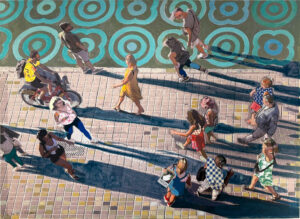
BARCELONA, 1967 Miguel Olivares
His career is defined by constant exploration, a diversity of artistic languages and the desire to make art an open, accessible form of communication, deeply connected to society.
His personal and professional experience in Colombia, where he lived for several years, has also had a significant influence on his artistic production, introducing new cultural, thematic and visual references. This international dimension has enriched an artistic language that has always maintained a close relationship with its surroundings and the people who inhabit them.
Miguel Olivares is a visual artist with an established career in the contemporary art scene, both nationally and internationally. His work is characterised by a distinctive visual language, born from the combination of traditional and contemporary elements, in which drawing, painting, collage and experimentation with different materials and supports come together to create an innovative, expressive and deeply personal artistic universe.
His connection with art dates back to childhood, when he discovered drawing and colour as a means of expression, a refuge and a particular way of understanding the world. Indeed, one of his earliest memories is associated with his fascination with colours, an experience that has shaped his approach to artistic creation. Initially, he was drawn to design, but soon discovered that his true vocation lay in Fine Arts. He graduated in Fine Arts from the University of Barcelona in 1990, specialising in painting while also exploring printmaking and sculpture. During his studies, a stay in Paris helped reaffirm his commitment to painting.
From the outset, Olivares has understood art as a field of constant exploration. His work combines traditional artistic techniques with contemporary resources, such as manipulated photography and digital creation. Drawing and painting coexist with graphic printing, mixed media and collage, one of the most distinctive features of his artistic production. In this field, he has developed a highly personal working method: rather than cutting paper and labels, he tears and manipulates them until he achieves the desired shapes, volumes and compositions. This approach to image-making allows him to play with textures, colours, proportions and scales, creating compositions full of movement and dynamism.
One of the central elements of his work is the representation of the human figure and everyday life. His characters, often anonymous, appear in urban scenes, walking through streets, gathering in meeting places or sharing seemingly ordinary moments. Through gestures, postures and expressions, Olivares creates visual narratives about human relationships, communication and coexistence. The figures, often dressed in patterns, logos and motifs taken from packaging and consumer products, establish a dialogue between people and their surrounding environment, while also questioning the relationship between identity, society and consumption.
His artistic production has evolved through the incorporation of new formats and materials. He has experimented with collage on wood, but has also transferred this visual language to flexible, rollable supports, expanding the expressive possibilities of the technique. At the same time, he has developed sculptural works, including transparent resin busts incorporating various objects, as well as drawings on metal in which colour becomes an element of figurative construction. In his paintings, urban, rural and dreamlike landscapes merge to create settings that move between reality and imagination.
Olivares began exhibiting his work in solo exhibitions in 1992 and has since developed an extensive exhibition career. Over the years, he has presented his work in numerous cities, including Barcelona, Madrid, Toulouse, Paris, Turin, Perpignan, Chicago, Los Angeles, New Delhi, Cali and Bogotá, as well as taking part in group exhibitions and national and international art fairs.
A particularly significant part of his career has been the creation of murals, installations and artistic interventions in public spaces. For Olivares, art is also a tool for communication, participation and social transformation, capable of moving beyond conventional exhibition spaces and establishing a direct connection with the community. Among his most outstanding projects is Bacatá, an 800 m² mural created in Bogotá in 2015, a monumental intervention that exemplifies his ability to translate his visual language onto a large scale. Other notable projects include Àgora, at the Catalonia Conference Centre; People, linked to FAD and also presented as a multimedia installation at the CCCB in Barcelona; interventions at L’Illa Diagonal; and Big People Up & Down, installed on Sant Jordi Street in Sant Cugat del Vallès in 2008.
His work in public art has been complemented by numerous participatory and charitable initiatives. These include Ready-Steady-Go; Trans-Art, in collaboration with Transports Metropolitans de Barcelona; Artistes joves en acció, promoted by the Government of Catalonia; Vaixell de paper, a charitable project in Barcelona’s Raval district; Artistas con narices, in collaboration with Clowns Without Borders; Arte para el Desarrollo, in the Dominican Republic; Mediterrània, at Moll de la Fusta; BCN>Bollywood>BCN, at the CCCB; Passarelle artistiques-Ville des Arts, in Casablanca; Jeunes 4 moteurs pour l’Europe, in Lyon; and Arma o semilla, in collaboration with the Spanish Red Cross at the Santa Mònica Art Centre. These projects highlight his commitment to bringing art closer to the public and transforming it into a space for encounter, exchange and collective reflection.
His personal and professional experience in Colombia, where he lived for several years, has also had a significant influence on his artistic production, introducing new cultural, thematic and visual references. This international dimension has enriched an artistic language that has always maintained a close relationship with its surroundings and the people who inhabit them.
Ultimately, Miguel Olivares has created a recognisable artistic universe in which colour, gesture, the human figure and collage take centre stage. His work combines spontaneity and craftsmanship, experimentation and technical skill, tradition and contemporaneity. Through a sensitive perspective on everyday life, he transforms ordinary situations and anonymous characters into compositions filled with energy, expressiveness and meaning. His career is defined by constant exploration, a diversity of artistic languages and the desire to make art an open, accessible form of communication, deeply connected to society.